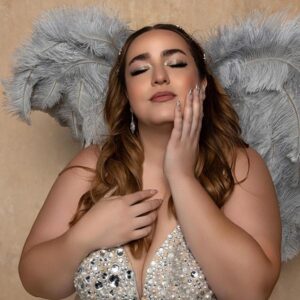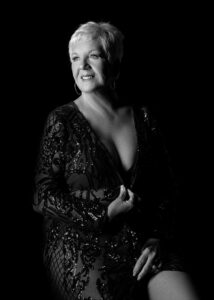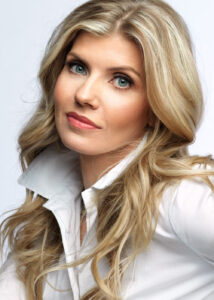
Boudoir poses for every body type come down to three things: where your weight sits, where your limbs create space, and where you are looking. Nothing about your body has to change for any of them to work. A pose that reads well on a five-foot-two frame reads well on a five-foot-eleven frame, usually with the camera moved a few inches. Below are the poses we use in the studio, why each works, and who handles what once the shutter starts.
What Makes a Pose Work
A pose works when it creates separation, a line, and somewhere for your eyes to go. Separation is space: between an arm and the ribcage, between the thighs, between chin and chest. A line is anything long and continuous, like a pointed toe or the run from shoulder to hip. Your eyes finish it. Into the lens reads as direct. Away from the camera reads as private. Both are good photos.
Flattering is a loaded word, so here is how we use it. A flattering pose shows you the parts of yourself you already like and lets you breathe normally while you hold it. It has nothing to do with covering anything up. If a position feels like a plank you brace through, it will look like one. The ones that empower people are the ones they can hold and then forget about.
10 Boudoir Poses for All Body Types
These flattering poses show up in almost every session we shoot, each with the reason it works, so you can ask for the pose ideas you want instead of guessing.
- Wall lean, weight on the back shoulder. Stand a foot off the wall and let one shoulder blade touch it. The gap between your back and the wall is what makes the shot read.
- Standing S-curve. Weight on the back foot, front knee soft and turned slightly inward, hips pushed one way and shoulders the other. This pose highlights the run from ribs to hip.
- Over the shoulder. Face away from the lens, then turn only your head back. Profile and back line in one frame, and the easiest thing to do in a first session.
- Seated on the edge, leaning forward. Sit on the edge of a bed or bench, elbows on knees, chin pushed forward. Leaning in puts your face closest to the lens, which is where you want it.
- Kneeling with hips back. Kneel, sit your weight onto your heels, arch gently, rest one hand behind the head. The arch does the work, so nothing gets held.
- Side-lying, top knee bent. Lying on a bed on your side, bend the upper knee toward the lens and rest your head on the lower arm. Two clean curves, zero tension.
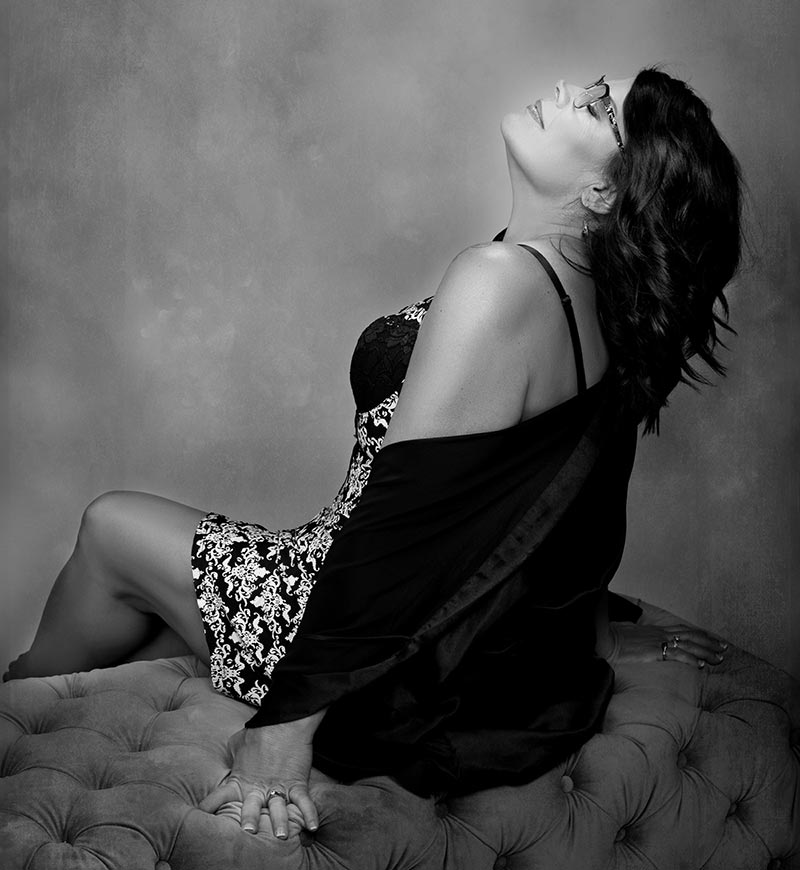
- On your back, head tipped back. Lie down with one knee up and drop your head so the shot catches your face in profile or upside down. It elongates the neck and it is restful.
- Seated pose in a chair, crossed at the ankle. Sit tall, cross low at the ankle rather than the knee, angle both knees off camera. Crossing low keeps the line of the leg unbroken.
- Hands in the hair, elbows wide. Both hands up, fingers loose, elbows opened out. Wide elbows build the separation that lets shoulders and waist read in front of the camera.
- Close crop on hands and fabric. A tight frame on collarbones, fingers, or a robe falling off one shoulder. Clients print these most, and they take almost no setup.
How Posing Shifts Across Body Types
The pose itself rarely changes. Camera height changes, how far you turn changes, how much the limbs travel changes. Here is where we start across five common body shapes.
| Frame | What we reach for first | Why it works |
|---|---|---|
| Petite | Extended legs, pointed toes, wall poses | Unbroken vertical lines read as length |
| Curvy | Side-lying, seated turns away from the lens, high-waist lingerie | Follows the shape already there instead of cutting across it |
| Athletic | Back shots, kneeling with a forward lean, movement frames | Side and back light catches definition a flat front angle misses |
| Plus-size | Reclining on pillows, a robe across the lap, chin forward | Soft surfaces let the body settle, a forward chin defines the jaw |
| Tall | Kneeling, close crops, camera raised slightly | Pulls the frame in, so the shot is about detail not scale |
Almost nobody is only one row. Most clients sit in two at once, which matters little because the poses overlap anyway.
What Your Photographer Directs, and What You Do
You are not expected to walk in knowing anything. In a boudoir session the photographer builds the shape and you supply the breathing and the expression. Knowing that split ahead of time removes most of the nerves.
The photographer owns the position, camera height, where the light lands, and the corrections that follow: turn the knee two inches toward me, drop the far shoulder, chin forward. Direction should be physical and specific. If someone is telling you to look sexy, you have been handed a feeling instead of an instruction, and that is when people freeze up.
You own three things. Breathe out as the shutter fires, because a held breath shows in the jaw and shoulders. Keep your fingers relaxed and slightly apart. Say something the second a position pulls.
One thing we tell every client before a shoot is that you do not have to know a single pose when you arrive. Posing is our job.
Hands, Eyes, and Expression
Hands are where most people get stuck. The fix is to give them a job. Touch something: hair, a robe hem, the edge of the bed, your own collarbone. Hands with a destination look relaxed, hands floating in space look staged. Keep the fingers separated and slightly curved, never flat, never in a fist.
For the face, push your chin forward and then slightly down. It feels ridiculous and it defines the jawline in every frame. Eyes go soft if you look a few feet past the lens, then flick back to it right before the shutter.
In our experience, the images clients end up loving are rarely the ones they saved on their phone beforehand. They are usually the half-laugh between two setups.
Where Posing Fits in the Rest of Your Boudoir Shoot
- New to this? Start with what a session involves, arrival to reveal.
- Where you land on the elegant to risque spectrum decides how much of the list above you use.
- Our guide to preparing for a first session covers the week beforehand.
- Outfits change positions more than anything else, so see where to buy hot outfits in Minneapolis.
- Professional hair and makeup holds up under studio light in a way a home routine cannot.
- Still comparing studios? Here is how to choose the perfect photographerfor you.
Booking Your Session in Northeast Minneapolis
We shoot this work in Studio Two at 308 E Hennepin Ave, third floor, in Northeast Minneapolis. It is a private room with soft textures and controlled light, and the floor has its own restrooms, a makeup room, and a wardrobe area, so nobody changes in a hallway. Inna Sumra shoots every session herself, and we tailor each one to the mood you want rather than a fixed shot list.
Bring two or three saved images and one sentence about what you would like emphasized. We build from there, starting with the easiest boudoir poses for every body type and working toward the more ambitious ones once you feel confident. Call (612) 200-8612 or book through our Minneapolis boudoir photography page.
Common Questions About Boudoir Posing
Do I need to practice poses before my session?
No. Ten minutes in a mirror teaches you which angles you like, and that is the whole benefit. Photographers direct continuously, and the frames that end up in your gallery are usually ones you would never have picked in advance. If you want to prepare, practice breathing out slowly.
Do boudoir poses require flexibility?
No. Every position listed above works at a normal range of motion, and the reclining and seated ones ask less of you than standing does. If something pulls, say so and we change it. A position held through discomfort shows in the face immediately.
What if I am nervous about how one part of my body will photograph?
Tell your photographer before the shoot starts and be specific. That one sentence changes camera height, pose selection, hand placement, and lighting for the whole session, and nobody is going to ask you to explain yourself. It is the most useful thing you can say in the first five minutes.
Who decides which poses we shoot?
Both of you. You set the boundaries and the mood, the photographer proposes the positions and the order. Most sessions open with seated and standing work while you settle in, then move to the reclining frames once you have seen a boudoir photo or two on the back of the camera.