The difference between elegant vs risque boudoir comes down to three things: how much coverage you keep on, how hard the light is, and whether you look away from the camera or into it. Elegant boudoir stays more covered, uses soft light, and reads as restrained. Risque boudoir shows more skin, uses sharper light, and reads as bold. Same studio, same photographer, same process. The only variable is where you sit on that spectrum.
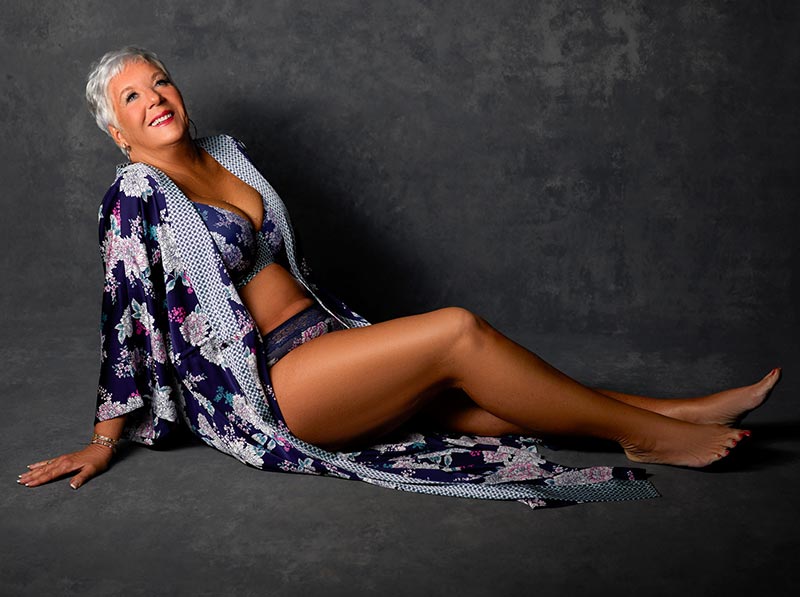
Most people land in the middle. The table below lets you point at a row at your consultation instead of deciding on set.
Elegant vs Risque Boudoir, Side by Side
Six things change between the two ends. Everything else about the session is identical.
| What changes | Elegant (classic) | Risque (bold) |
|---|---|---|
| Typical coverage | Levels 1 to 3 (scale below) | Levels 3 to 5 |
| Wardrobe | Delicate lace, a silk robe, a slip, an oversized sweater | Corsets, garters, sheer panels, leather |
| Lighting | Soft and diffused, low contrast, shadow conceals | Directional and harder, high contrast, shadow sculpts |
| Posing | Turned away, glance over the shoulder, eyes closed | Open, squared to the lens, direct eye contact |
| Mood | Quiet confidence, timeless, restrained | Playful, unapologetic, high energy |
| Usually kept as | A fine art wall piece or a bedside album | A private album or a locked phone folder |
What the Elegant End Looks Like on a Shoot
Elegant boudoir photography is the restrained end: soft light, partial coverage, sensuality implied rather than stated. Wardrobe leans toward delicate lace, a silk robe, a slip, or an oversized sweater, and light and shadow carry the frame, shaped so the shadow conceals about as much as it reveals. That restraint is why these images survive being printed large and hung on a wall. It’s the usual pick for bridal boudoir, anniversary albums, and anyone who wants artistic portraits of themselves first, a gift second.
The honest trade-off: low contrast light is forgiving, but it’s quiet. If you want images with obvious heat in them, this end reads as too gentle.
What the Risque End Looks Like on a Shoot
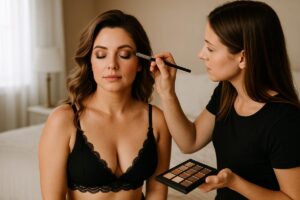
Risque boudoir photography is the bold end. Less fabric, harder light, direct eye contact. Wardrobe runs to corsets, garters, sheer panels, and leather. Lighting turns directional, with sharper edges and deeper falloff, because contrast reads as energy. Poses open up and square to the camera, and professional hair and makeup usually goes heavier, closer to glamour than to natural.
The trade-off runs the other way. These are harder pictures to hang in a hallway, so settle the delivery format before the shoot.
Five Coverage Levels, and Where Most Clients Stop
Coverage is worth settling before you book, and it’s easier as a numbered scale than as adjectives.
- Level 1, fully clothed. An oversized sweater, an unbuttoned shirt, a bodysuit with jeans. Nothing comes off on camera.
- Level 2, classic lingerie. A matching set, a slip, a one-piece. Roughly what a swimsuit covers.
- Level 3, sheer or structured. Corsets, mesh, sheer panels. Covered, but less opaque.
- Level 4, strategic coverage. A sheet, a robe held shut by an arm, a position that does the covering. Often called implied.
- Level 5, implied nude. No garment, with the crop, the body, and the shadow doing the work. Nothing explicit in frame.
Elegant sessions generally run levels 1 through 3, risque sessions 3 through 5. Every studio draws its own line at the top of that scale, so ask where it sits when you book, not while you’re changing.
Decide Who Sees the Photos, Then Pick the Look
The audience question settles the coverage question faster than any mood board. Pictures made for a partner can sit anywhere on the scale. Pictures you plan to frame, or leave where a relative might find them, have to survive that context alone. One thing we ask every client before a boudoir session is who they picture looking at the final images five years from now. If the honest answer is “just me,” you have more room than you expect.
Your comfort level isn’t fixed either. Starting at level 2 and finishing at level 4 an hour later is common, once you’ve seen frames on the live view screen.
How to Find Your Spot on the Spectrum
- Save six pictures you’d want to look like, then count how many sit in each column. The split is usually lopsided.
- Name your ceiling coverage level, then pack one level below it. Somewhere to go beats nowhere to stop.
- Say that number out loud at the consultation. A photographer who asks follow up questions is doing the job.
The rest of this cluster covers mechanics rather than aesthetics: what happens during a session, preparing for your first shoot, where to buy outfits locally, posing for every body type, what hair and makeup adds, and how to choose a photographer in Minneapolis.
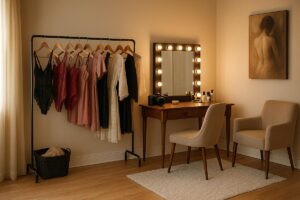
We photograph this work in Studio Two at 308 E Hennepin Ave, third floor, in Northeast Minneapolis, a room built for controlled light and soft textures, with a private restroom, makeup room, and wardrobe area. Inna Sumra shoots every session herself. Learn more about the boudoir photographer sessions.
Common Questions About Elegant vs Risque Boudoir
What counts as a risque picture?
In a portrait studio, risque means coverage levels 3 through 5: sheer or structured pieces, strategic coverage, or implied nude. It does not mean explicit. Get the studio’s upper limit confirmed in writing before you pay a deposit.
What are the different styles of boudoir?
Five come up regularly: classic or elegant, glamour (heavier hair and makeup, more polish), bridal, fine art (light and shadow as the subject), and risque. Most shoots blend two rather than picking one.
What should I avoid wearing?
Skip tight elastic, visible logos, and anything that doesn’t fit properly. Elastic leaves marks that can take 20 to 30 minutes to fade, so travel in loose clothing and change at the studio.
Whichever end you pick, the deciding factor in elegant vs risque boudoir is your own comfort, not what a photographer or a partner prefers. Choose a coverage level, name it before the camera comes out, and treat the spectrum as yours.